Reading Weather Radar Before a Fishing Trip
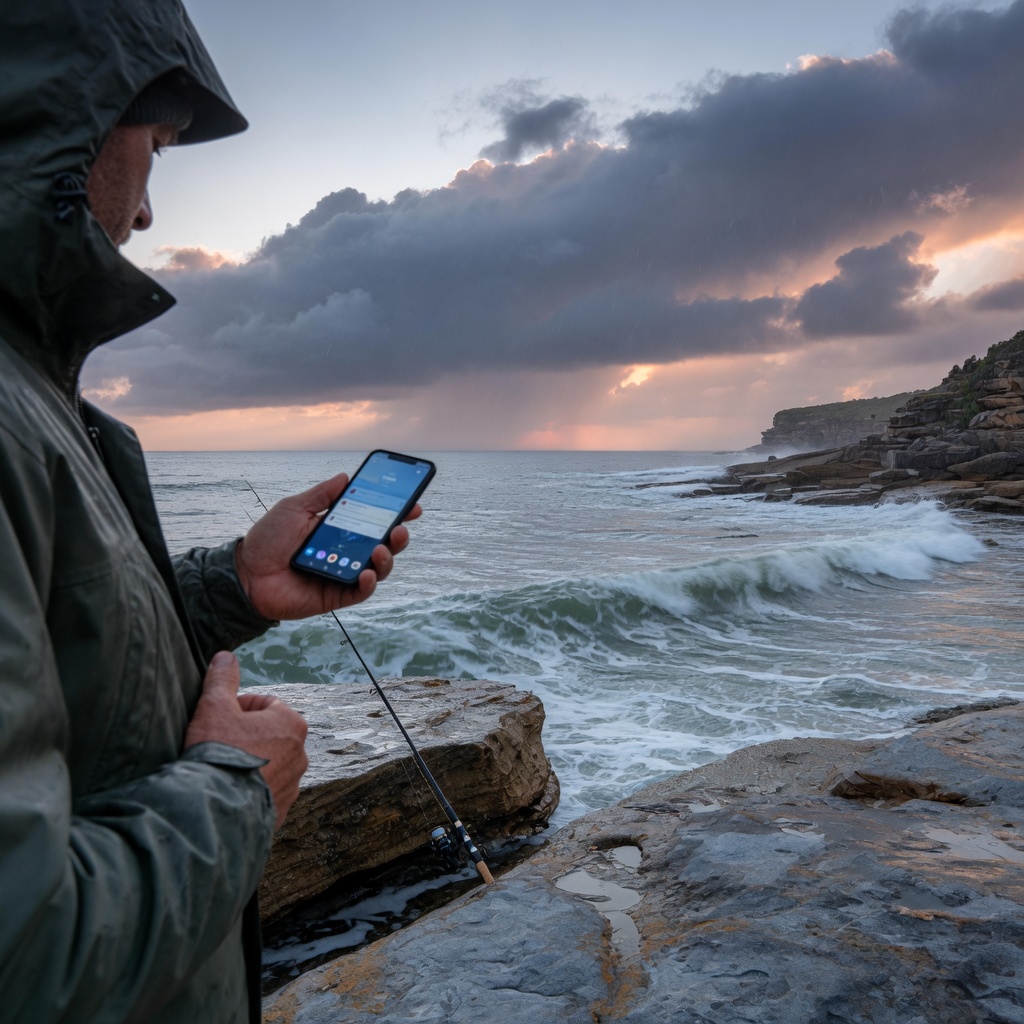
Why Radar Matters More Than the Forecast Icon
A single sun-and-cloud icon tells you almost nothing about the next four hours on the water. Weather radar shows you what is actually happening right now: where rain is falling, how heavy it is, which direction cells are tracking and how quickly they are building or falling apart. For anglers around Sydney, that difference decides whether you fish the last two hours of the run-out tide or sit in the car park watching a squall line march up the coast.
Radar works by bouncing a signal off raindrops and hail. The colours you see are rainfall intensity, not cloud. Light blue and green usually mean drizzle to steady rain that you can fish through in a decent jacket. Yellow and orange mean heavy rain, often with gusty wind at the leading edge. Red and purple signal intense cells, hail and downdrafts — that is the point to be off the rocks and off open water, no exceptions.
The Five-Minute Pre-Trip Radar Routine
- Open the radar at the widest range first (roughly 250 km) to see the big picture and any approaching front.
- Step in to the 128 km view and note the direction of travel. Watch three or four consecutive frames in the loop, not a single still.
- Estimate speed: if a cell has covered a third of the distance to your spot across a 30-minute loop, you have roughly an hour before it arrives.
- Zoom to the local view for your exact headland, beach or estuary arm. Coastal showers often hug the escarpment or the harbour and miss ocean beaches entirely.
- Cross-check with wind and swell before you commit — radar alone never tells you if a ledge is safe.
Reading Radar Together With Wind and Swell
Rain rarely bothers fish. Wind and swell decide comfort and safety. A radar loop showing a line of showers tracking from the south-west usually arrives with a wind change, and that change is what flattens a sloppy nor'easter into fishable water — or turns a calm estuary into whitecaps.
- Nor'easter (summer afternoons): builds from late morning. Fish early, or work the western banks of estuaries where the bank blocks the chop.
- Southerly change: radar often shows a distinct band ahead of it. Expect a sharp gust front, dropping temperature and rising short-period swell.
- Westerly: flattens the ocean surface and makes beach and rock fishing pleasant, but it pushes small boats offshore quickly.
- Swell period: a 1.5 m swell at 14 seconds carries far more energy onto a ledge than 1.5 m at 8 seconds. Long-period swell is the one that catches people out.
Radar, Tide and Moon Phase Working Together
The best sessions stack conditions. A run-out tide at dawn, a light offshore breeze, a clearing radar picture after overnight rain and a moon phase near new or full is close to ideal for estuary flathead and bream around Sydney. Freshwater run-off after rain pushes bait and prawns down the system, and the discoloured line where dirty water meets clean is worth casting along for hours.
After heavy, sustained rain, give upper estuaries a day or two to settle and fish closer to the mouth where the water clears first. Check the radar history, not just the current frame, so you know how much water has already gone into the catchment.
Safety Calls You Should Not Negotiate
Rock fishing is the highest-risk form of shore fishing in Australia. If the radar shows an intense cell within an hour, or the swell forecast is rising, choose a sheltered estuary instead. Wear a lifejacket and cleated boots, fish with a mate, watch a ledge for at least fifteen minutes before stepping onto it, and always know your exit route. Lightning within about 10 km means put the graphite rod down and get under solid cover.
Build Your Own Local Pattern
Keep a short log for every trip: radar picture, wind direction and strength, swell height and period, tide stage, moon phase and what you caught. After a season you will spot patterns no general forecast can give you — the beach gutter that only fires on a rising tide with a light westerly, or the harbour wall that switches on as the first showers arrive.
Have a question about conditions at a spot near you? Reach Tide Fishing on +61292658222 or [email protected] during Mon–Fri: 09:00 – 17:00 (AEST), and browse our tide, swell and moon phase guides for Sydney before your next session.

Navigation
See also
FAQ